India is a land of mysteries and magic. Like the mystery of Roopkund Lake there are many unsolved hidden mysteries whose answers have not yet been found.
Some of these unexplained wonders have no scientific basis and may very well be a fragment of imagination. Yet many are fascinated by them and are trying to unfold these mysteries through research and exploration in order to get to the bottom of these puzzling stories that are hundreds or thousands of years old.
The Mystery of Roopkund Lake
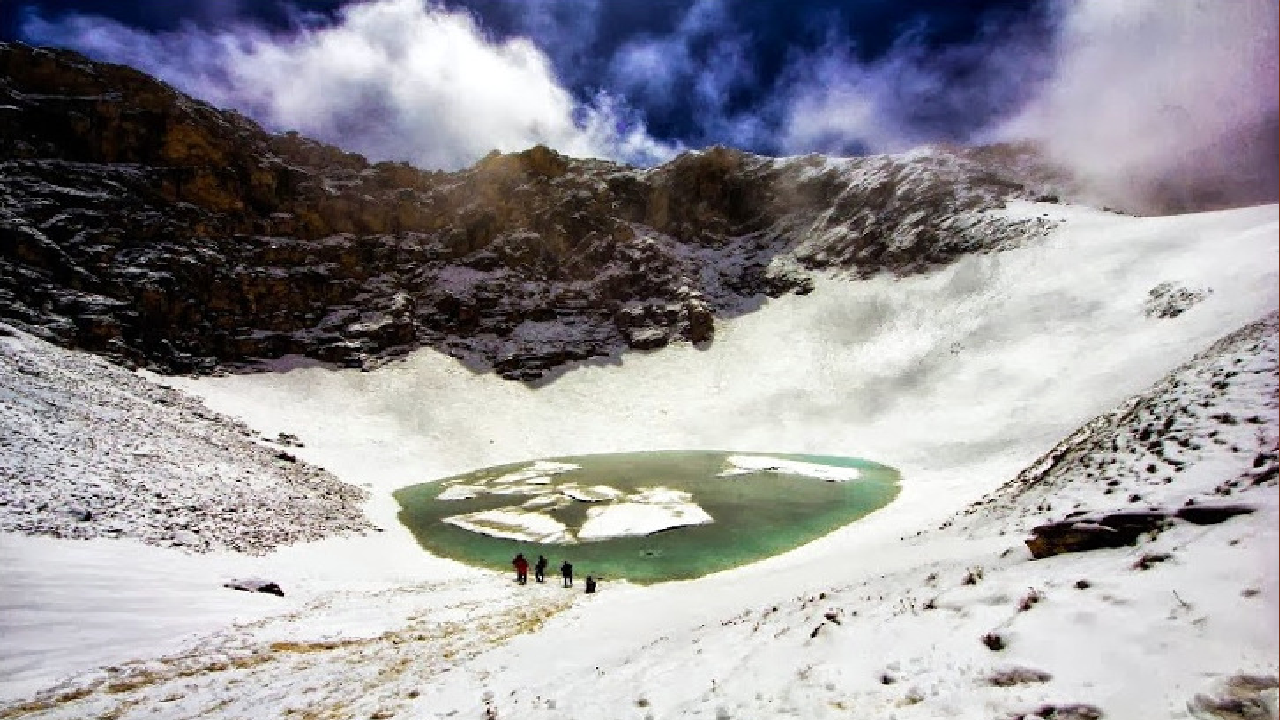
One such unsolved mysterious place is the Roopkund Lake in the Himalayas. It is situated approximately 16,000 ft above sea level in the Chamoli district of Uttarakhand in India.
It is famous as the ‘skeleton lake’ because hundreds of skeletons were discovered in and near the frozen lake. It is surrounded by snowclad mountains and is popular among those who love trekking.
The skeletons found near the lake and at the bottom of the lake have remained a mystery with no concrete evidence as to the real truth behind how they happened to be found there. Explanations are a mixture of science and folklore.
The human bones were discovered by a man named Hari Kishan Madhwal, in 1942. He was working as a British forest Ranger and was patrolling this part of Garhwal when something very unusual met his eyes.
He was shocked to find hundreds of human skeletons lying on the shore of this lake. They had not been buried but lately strewn here and there.Total decomposition had not taken place due to the snow and the severe cold weather.
The Research Work Into The Mystery of Roopkund Lake
Research work started as groups of enthusiastic scholars put in their best efforts to find the truth behind the skeletons. At first investigation pointed at the most logical theory that since the 2nd world War was going on these skeletons may supposedly belong to the Japanese soldiers who must have tried to enter India through the Himalayan ranges.
However a DNA test proved this theory completely wrong because tests showed that these bones were many years older maybe a century old. Another theory identified the bones as belonging to the army of General Zorawar Singh of Kashmir, who must have lost their way and died here.
This event must have occurred around 1841. This assumption was also proved wrong as the bones found were still older, roughly about the 12th or 15th century.
Time and again different theories kept coming up and no conclusion could be drawn. Then there was a story linked to deaths due to disease and some came up with a theory about mass suicide. The puzzle could not be completed.
The Local Folklore
Then came a local belief or a folklore which has passed down from generations. It was the story of the King of Kanauj who wanted to pay his respects to Goddess Nanda Devi on the birth of his child.
But on their way to the pilgrimage, the men and women accompanying the king showed disrespect towards the sacred mountains by violating the rules. Their singing and dancing angered the local deity who punished them by raining down hail stones.
They were so large that some died as it fell on their heads thus breaking their skulls. As they had no place to take shelter, some jumped into the Roopkund lake and got drowned. A scientific research team supported this theory because close examination of the skulls showed that the injury had been caused by a round object which had fallen only on top of their heads thus breaking the bone of their skulls and killing them.
Although the cause of death was ascertained, there is still no concrete evidence about who these people were what their real identity was.The bangles found there proved that there were women along with men. Reports say that about 600 to 800 skeletons were discovered in and near the lake.
Anyone looking for pure adventure and for someone who loves trekking, this is an ideal place with ample opportunity to fulfill their heart’s desire. The scenic beauty adds to the charm this lake carries. The trekking path although meant only for experienced trekkers is a feast to the eyes as it is surrounded by lofty snow covered mountain peaks and grassy fields filled with wild blossoms found only at such heights.
During summer months, which is considered to be the best time for trekking, the thawed lake gives you a view of the skeletons at the bottom. However it is a pity that sufficient steps have not been taken by the Government to protect this lake from intruders and people with ill-intentions who get the opportunity to steal and carry off many precious artifacts and skeletons lying near the lake.
Such rare objects which can be traced down to many centuries, should ideally have been secured and protected by the Archeological department. Inspite of all this, Roopkund Lake continues to be one of the most haunting and captivating mysteries found in India.