Odisha is home to 62 indigenous tribal communities. Most tribal groups depend on agriculture, forest products and handicrafts for their livelihood. Some of the largest and most prominent tribes include the Kondh, Bonda, Santal and Saora.
- The Dongria Kondh live in the Niyamgiri Hills and are known for protecting their forests from Bauxite mining.
- The Bonda reside in Malkangiri. They have a unique traditional dress and a matriarchal social structure.
- The Santal are a vibrant community with a rich history of resistance against Colonial rule.
- Saoras are known for their ancient shamanic traditions and intricate Idital wall paintings.
The Lanjia Saora is one of the most extraordinary tribe. The community is known for their constant dialogue with the invisible world. This is done under the guidance of female shamans who become the bridges between the world of the living and the other realm which is that of the dead.
Their existence is mentioned in the epic Ramayana. Supposedly descendants of Austro- Asiatic clan, they settled down in the rugged hills found in the central parts of Rayagada and Gajapati districts. Their language, primarily saora which is a part of Mundari branch, follows an oral tradition except for a sacred alphabet “sorang sompeng”used in their ritual chants. The Lanjia males are always seen carrying an axe over their shoulders as some believe that the word saora has been derived from’ sagories’ or the scythian word for axe. They are also recognized as exceptional in farming as they arduously cut down the hills to create terraces for rice plantation and other crops.
The word ‘lanjia’ has been derived from the traditional loin cloth worn by men which hangs in front and behind, like a tail of an animal or lanja as said in the local language.
The women of this tribe can be identified by their ornamentation which is a wooden disc worn in their ear lobes and facial tattoo called ‘tantangbo’ which is a line extending from their forehead to their nose. This is further highlighted by dots on their cheeks and forehead. The women believe that this is true adornment as jewelleries that will remain on earth after they die but these tattoo marks will remain even after they die which will help their ancestors to recognize their souls in spirit world. An interesting story about their origin is found in the Kureitung Katabir, according to which the first Saora man originated from Kureitung(bottle gourd).
The Idital: the symbol Of a Sacred Cult
The religious beliefs of this Lanjia Saora tribe is very different and unique as compared to other religions. Their shamanic and animist system discards the existence of boundary between the living and the dead. According to them, their deities referred to as ‘ Sonams’ reside in nature like trees, cliffs and rivers. They are also found in the form of the Spirits of their ancestors who never leave home after death and instead continue to interact with them. It’s a popular belief that if these Spirits are honoured, they in turn offer protection but if they are ignored then their anger is manifested by bringing about illness on the descendants.
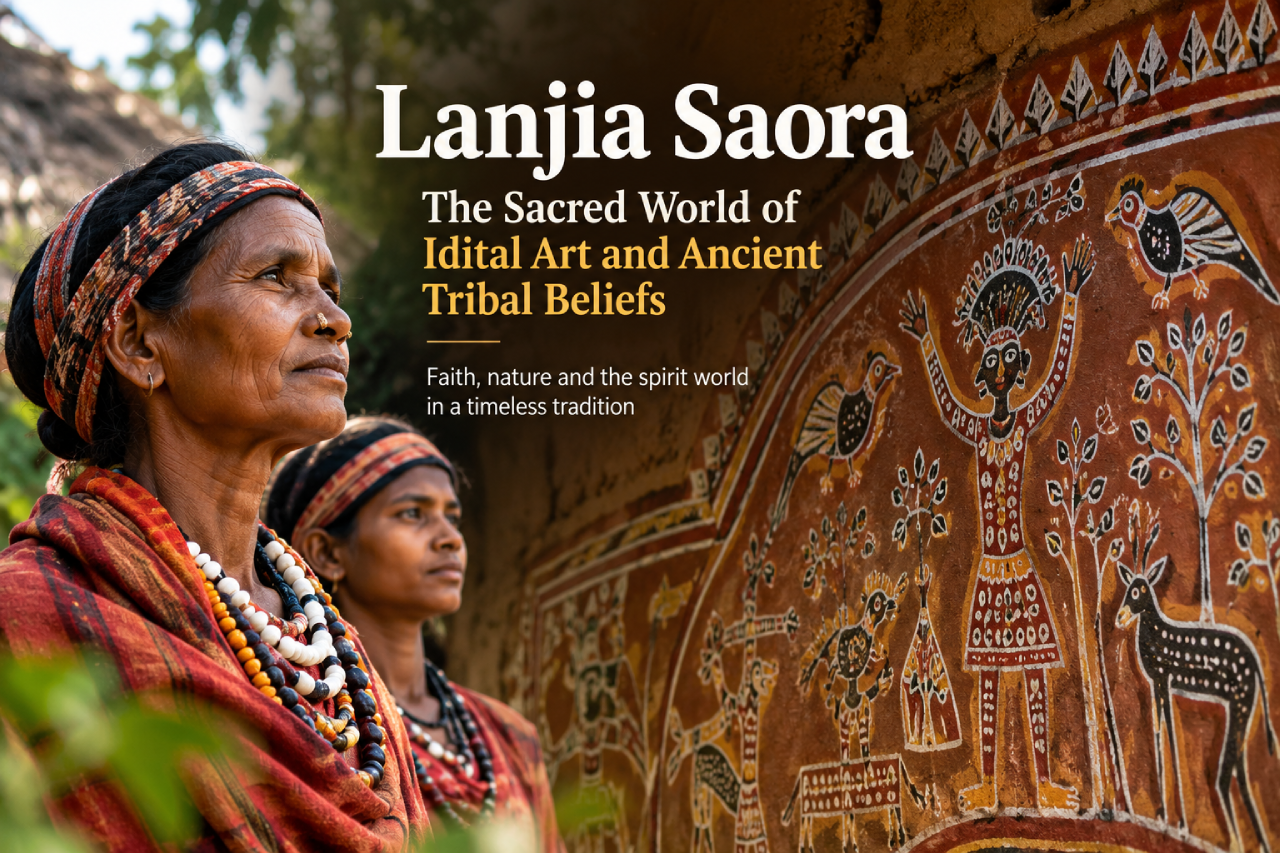
The Spirits are thus honoured by creating an Idital mural. This traditional painting is done only by a shaman, also known as a “Kundan”. There is an interesting belief behind the making of this mural art. The Shaman first goes into a trance during which she identifies or interacts with the spirit of an ancestor who is either angry or pleased. The spirit wishes to be appeased and dictates what to include in the Idital. It may be a horse, or a tree or sometimes modern objects symbolic of power.
Thus each Idital mural painting is unique, created in this way by following the instructions of a spirit. After it is completed, certain rituals are performed to activate the Idital. Every Idital follows a particular pattern which includes a frame which is symbolic of the walls of the palace where the spirit lives and this is filled up with all the elements as desired by the spirit. Rice flour paste is used to paint the Idital as it is considered pure. The background is painted in red ochre, the soil of the iron-rich hills which is symbolic of blood and fertility.
Another special feature of this Lanjia tribe is the high position conferred on women unlike other religions where nearly all religious rituals are performed by men. Here only female shaman is the bridge between the two worlds also known as the “Kundan Boi”.
The kundan Boi is believed to be the mystical wife of the spirit who appears to the female shaman in her dream and offers diagnosis and remedies for any illness suffered by the people of the tribe. During the performance of the rituals, the female shaman first goes into a trance and then her voice changes to a male voice which signals that she has been possessed. It is through this voice that the demands or any solution suggested by the spirits, can be understood by others.
However with the changing times, very few female shamans are alive who will carry forward this heritage. According to one female shaman, the younger generation is unwilling to learn this art. The reasons may be many. Due to religious conversions done by Christian missionaries, education, modernization and the difficulty of following this procedure, most young girls are turning away from the whispers of the Spirits and instead looking forward to embracing the magic of the modern world. Thus the passing away of the shamans will bring an end to a magical tradition where human beings still knew how to interact with Gods.