
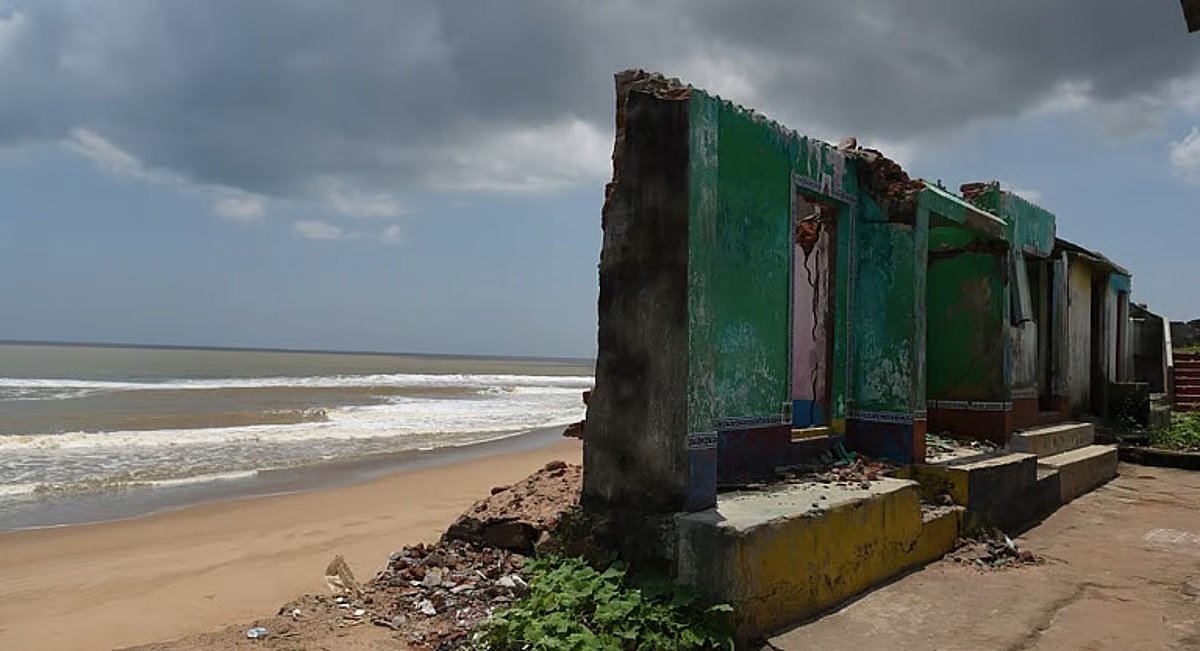
Podampeta was a small fishing village on the eastern coast of India. At present there stands on the edge of the shore, a few precariously balanced ruined houses which had once thrived there. The advancing waves of the sea have eroded the shore, thus taking in its grasp the tiny village named Podampeta.
Whatever might be the reason behind such a disaster, but the tidal action and coastal erosion has gradually taken its toll. As a result of this, the people who were primarily fishermen by profession called the Noliyas, were forced to relocate around the year 2007 to another place which was an inland, named New Podampeta. The eroded remnants of the houses are a silent witness to a past which belonged to a community of fishermen across the shores of Odisha and Andhra Pradesh.
This community continued to live here amidst uncertainties and impending dangers of the advancing sea approaching slowly but surely to swallow the sandy expanse of the shore. Although the Noliyas were aware of this fact which they usually expressed to outsiders saying that the “the sea will eat us”, yet their love for the roaring waves and fishing did not allow them to leave. In their narratives they are nostalgic about the past when they woke up with a view of the sea in old Podampeta. Their love for the sea keeps bringing them back to the shores whether they go fishing or not, but they believe that though their homes are consumed by the ravaging waves yet as long as they are able to see the sea , they will remain safe.
There have been many instances when their faith has been tested. The shrine of their Goddess, Neelamma, where the fishermen used to offer prayers, seeking the blessings of the Goddess before venturing into the sea was also submerged by the ocean. However, the people of the community persisted and rebuilt the temple of Goddess Neelamma. Now she stands watching and guarding the fishermen as they confront the fury of the sea. Their story is a paradox of hope and loss. Thus, amidst this daily threat of climate change, they continue to face these challenges, coping and responding with resilience.
Another change brought about by the rising waters is the disappearance of the nalilu, a type of crabs which the fishermen used as baits for fishing, children caught playfully and women cooked them into meals. But in spite of this, they continue to search for the nalilu which was not just a crab but a way of life which is gradually slipping away and to which the tribe is clinging on, not ready to accept and let go. Just like the nalilu, the houses, the shore on which the children played, the dunes are also gone which once upon a time protected them from cyclones and eroding shores. Life goes on desperately trying to retain the past, but will they be able to relive and bring back the joy of waking up to the sound of the sea with its waves crashing against the shore, the sea which beckoned them towards it giving them their source of livelihood.
It has now been declared a prohibited zone after a recent incident when a concrete structure was washed away by the powerful waves.
The residents are demanding immediate Government intervention to take necessary precautionary measures in order to protect the coastline and safeguard their livelihood. Everything said and done, man is helpless before the ravages of nature and these natural disasters are nothing but the result of man’s thoughtless exploitation of nature which is paying us back in its own terms.



Most relevant post