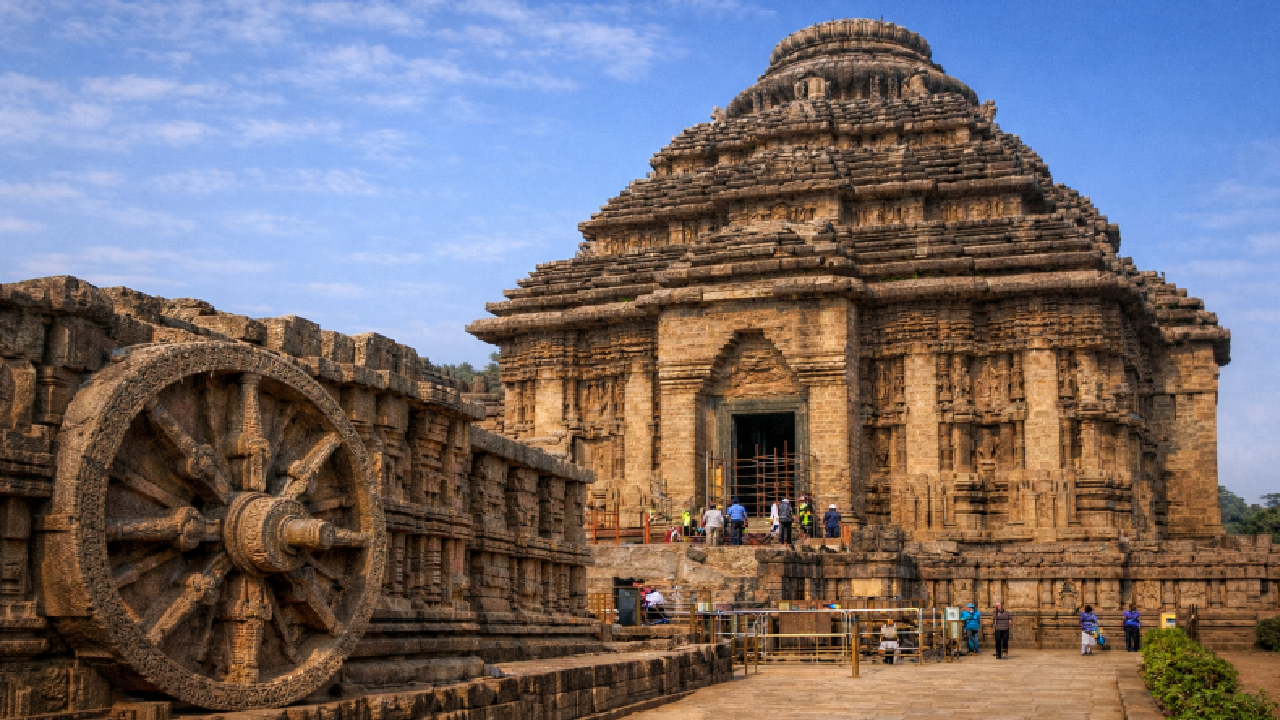
The Konark Temple a mesmerising wonder in stone! Ever wondered what the black pagoda refers to. This was what the European sailors called the very famous Konark Temple or the Sun Temple.
This is because it acted as a landmark for sailors in the high seas. This huge structure was built around 1250 CE, by King Narasimhadeva of Eastern Ganga Dynasty, situated 35 kms northeast from the famous city of Puri in Odisha.
It was shaped like a chariot designed for Hindu Sun God also called Surya Devta. The elaborate design depicted seven horses pulling the chariot which stood on 24 stone wheels which had been carved intricately. The 24 wheels also represented 24 hours of a day as Sun dials.
The Konark Temple built in the 13th century took 12 long years to be completed. Not only is the Sun Temple famous for its architectural design and its unique shape but also there are many legends associated with the making of this massive structure. Approximately 1200 workmen or artisans were involved in the construction of this temple.
The responsibility of this construction work was entrusted to two persons. One was Sibei Samantaray Mahapatra and the other was Bishu Maharana, who was the chief architect. The men chosen to work here were highly experienced and talented. Although the soil of the construction site was not good, Bishu Maharana had no other option but to start the work there, next to the sea.
The name Konark is derived from combination of two sanskrit words, ‘kona’ meaning corner and ‘arka’ meaning Sun God. Now, the King Narasimhadeva put a condition before the artisans. He declared that no one involved in the construction work would be allowed to go home until the temple is completed.
Lot of hard work went into the construction as the temple was carved out of stone and finally after 12 long years the major part of the temple was completed. In the meantime we have another interesting legend associated with the Konark Temple.
The Legend of Dharmapada And Konark Temple
Dharmapada was the name of the 12 year old son of the chief architect, Bishu Maharana. This child had never seen his father as his father had left home soon after the birth of his son. Dharmapada’s mother hardly spoke about her husband. Hence on his 12th birthday Dharmapada asked his mother for a gift in the form of information about his father.
On hearing about the construction of the temple, Dharmapada expressed his desire to meet his father whom he had never seen before. When Dharmapada met his father, his joy knew no bounds. Although Bishu was also very happy to meet his son, Dharmapada felt that his father was disturbed about something. On insisting, Bishu Maharana shared the reason behind his anxiety.
Inspite of the fact that the temple was nearly complete, the main work which was the ‘Kalasha’ or the head of the temple could not be fixed. Several efforts to fix it had failed. All the artisans were extremely worried and afraid because the King had given them only one day to fix it.
If they would fail, then the King had threatened to behead all of them. Hearing this, Dharmapada who had read about architecture from some documents kept by his father, requests to try to fix it. Although he was only 12 years old, he was determined to save the lives of his father and the 1200 artisans.
He climbs to the top of the temple and corrects the defect, thus successfully fixing the kalasha. This extraordinary achievement by this young boy makes all the artisans very happy as their lives had been saved.
But this celebration is short lived when they realize that the King would be very angry to know that this little boy was able to do what 1200 trained artisans were unable to do. This fact could not be hidden from the King. When Dharmapada hears this, he again climbs onto the top of the temple and jumps into the Chandrabhaga river, thus sacrificing his life to save the life of others.
Even though thousands of years have passed and the temple is in ruins, the name of Dharmapada is still remembered to this day. Most probably that is the reason why no one ever worshipped in this temple which cost the life of a young boy.
Mystery behind why the Konark Temple was abandoned
There are many reasons as to why such a beautiful piece of architecture built with do much hard labour and time, was abandoned and left in a broken condition.
One of the legends is regarding the death of Dharmapada, the 12 year old son of Bishu Maharana, the chief architect of the temple. Dharmapada ended his life by jumping into the Chandrabhaga River because he wanted to save the lives of the 1200 artisans and their families. But it is believed that Dharmapada was actually an incarnation of Sun God, who had come to crush the ego of the King.
Although the temple was symbol of the King’s pride, no rituals or worship could take place there and the temple was finally abandoned. The temple was damaged with the passage of time. Yet even now when you look at it, the unmatched majesty of the black granite temple stands out.
But what remains is only the front hall or the ‘Mukhasala ‘which has been sealed with stones and sand. Various theories try to justify why this temple was damaged but there is no authenticity regarding these legends, though they are very fascinating. The temple was made of stones carried from the caves of Khandagiri and Udaygiri and were fixed together by iron rods.
This iron frame was held by a huge magnet which was believed to be 52 tons in weight and was known as ‘Lodestone’. In the middle of the temple hung the ashtadhatu (made of eight metals) idol of the Sun God. The hanging statue was an enigma for many years till the secret of the magnet was discovered. But the magnetic field created by this powerful magnet had its impact on the ships passing by, pulling them towards the temple.
Later it is said that the Portuguese sailors removed the magnet in order to protect their ships and took it with them. It is believed that the removal of the magnet made the temple collapse as the iron frame was held together by the magnet. It is not known whether the idol of Sun God was also taken by them or was later moved to the precincts of the Jagannath Temple in Puri.
Yet another legend about the destruction of this temple is connected with an Afghan ruler of Bengal named Sulaiman who wanted to conquer Odisha. But Rajib Lochan Ray or Kalachand, who was the General of the last Emperor of Kalinga, defeated and foiled Sulaiman’s attempts.
Sulaiman decided to trap Rajib by making him fall in love with his beautiful daughter. Rajib Lochan was enamored by the beauty of Sulaiman’s daughter and wanted to marry her. So Sulaiman asked him to get converted to Islam religion. But Rajib wanted to get Sulaiman ‘s daughter converted to Hinduism. However when the Hindu Pandits opposed this proposal, Rajib converted himself to Islam and invaded Odisha which was Kalinga, then.
He ruthlessly destroyed many temples and the Konark Temple was one of them. This story of the invasion of Rajib Lochan Ray as ‘Kalapahad’ is very famous. Some fix the responsibility of the destruction on natural calamities like lightning or earthquake which has never been on record.
Thus the actual reason behind the destruction of the amazing Konark Temple remains a mystery even to this day. Attempts made by the Archeological department to repair and restore the temple, have not been successful. Thus the Konark Temple can be listed as one among the amazing mysteries of India and a popular tourist destination.